
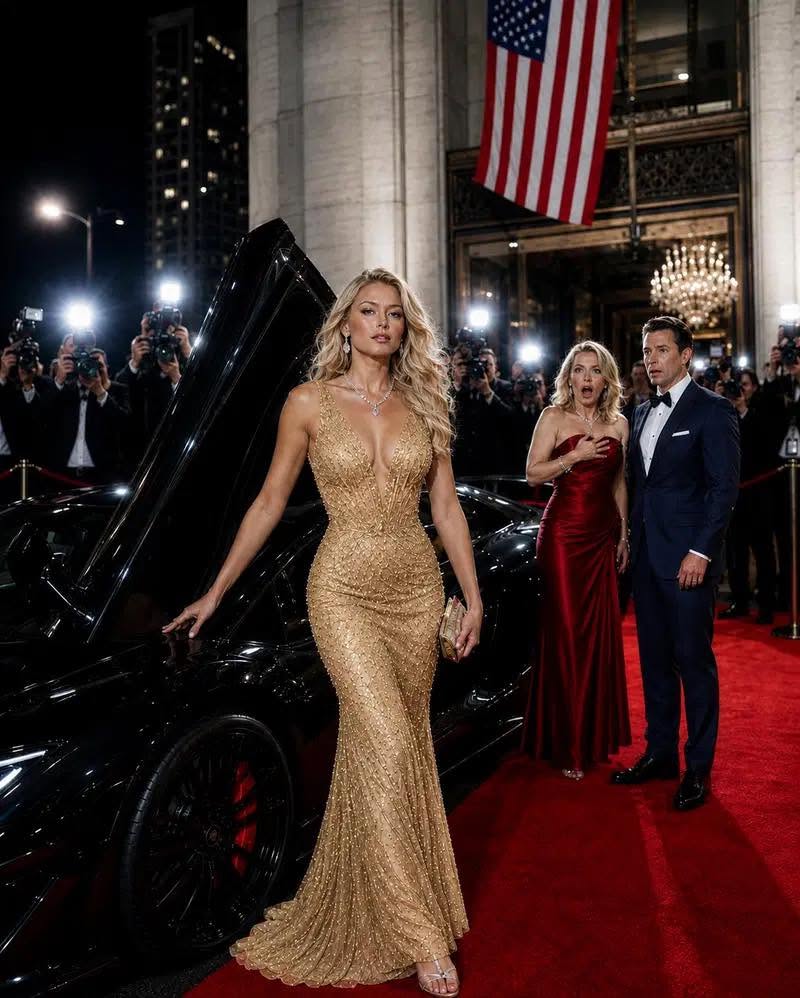
PART 3
Claire did not throw herself into the river.
She kept driving until the rain smeared across the windshield and sorrow made the road twist strangely beneath the headlights. Somewhere beyond Savannah, she turned onto an old service road and sat trembling behind the steering wheel.
Her wedding ring felt heavy on her finger.
Heavy with promises.
Heavy with deception.
Heavy with every moment she had smiled while Bennett and Marissa stripped pieces of her dignity away in public.
She removed it and set it on the driver’s seat.
Then she wrote the note.
I can’t do this anymore.
She was not talking about life.
She meant Bennett.
She meant the house.
The name.
The performance.
The woman she had forced herself to become in order to survive them.
Then she walked into the storm.
Rain drenched the gold dress against her body. Mud swallowed her heels. Branches scraped her arms. She fell twice. Once, she remained on the ground long enough to wonder whether vanishing forever might be easier than explaining she was alive to people who had already accepted Bennett’s version.
Then headlights sliced through the trees.
A pickup truck pulled to a stop.
An older Black woman in a yellow raincoat stepped out, holding a flashlight.
“Good Lord,” the woman said. “Baby, are you trying to get yourself killed?”
Claire tried to answer, but her legs folded beneath her.
The woman caught her.
Her name was Ruth Delgado.
She owned a roadside diner twenty miles south of Savannah and lived in the apartment above it. She had no husband, no tolerance for fools, and a baseball bat she called “insurance.”
When Claire woke up, she was lying in a small bedroom beneath a faded quilt. Her dress was draped over a chair. Her arms were wrapped in bandages. A mug of tea waited beside the bed.
Ruth sat by the window with the bat resting across her lap.
Claire blinked. “Are you guarding me?”
“Depends,” Ruth said. “Is somebody coming?”
Claire broke into tears.
Ruth did not rush her. She allowed Claire to cry until the crying turned back into breathing. Then she fed her eggs, grits, toast, and coffee strong enough to frighten the dead.
After breakfast, Ruth said, “Start at the beginning.”
Claire told her everything.
Not in order.
Not courageously.
But Ruth listened without pity and without asking even once what Claire had done to make Bennett look elsewhere.
When Claire finished, Ruth leaned back.
“So your rich husband cheated with your best friend, threatened to ruin you, and you left him a ghost story.”
Claire wiped her face. “I didn’t know what else to do.”
Ruth nodded. “Good.”
Claire stared at her. “Good?”
“Men like that don’t fear tears. They fear uncertainty.”
Three days later, Ruth called her nephew, Daniel Price, a corporate attorney in Atlanta.
Daniel arrived in a navy suit, carrying a leather briefcase and the expression of a man prepared for nonsense and accustomed to billing by the hour.
He read the prenup.
Then he read it again.
Then he looked at Claire.
“Your husband is arrogant.”
“That’s your legal opinion?”
“My personal opinion. My legal opinion is better.” Daniel tapped the document. “This protects his inherited assets, but it does not cover independent business income, intellectual property, or assets acquired after separation. If you build something, he cannot touch it.”
Claire almost laughed.
Build something?
For years, she had been told she was sweet, decorative, ordinary. Useful as a wife. Useful as a pleasant smile. Useful as a name printed on invitations.
“What would I build?” she whispered.
Daniel studied her. “What do you know?”
Claire thought of Bennett’s late meetings. The hotel acquisitions. The zoning battles. The financing structures he discussed over dinner because he assumed she was too gentle to understand. The charity housing initiative she had practically managed while Bennett accepted credit at the ribbon cutting.
“Real estate,” she said slowly. “Hospitality. Community development. Project financing.”
Daniel nodded.
“Then we start there.”
At first, Claire did not become a billionaire.
At first, she became a woman using a false last name, a secondhand laptop, and a room above a diner.
She cut her hair shorter.
Dyed it darker.
Opened a small consulting firm under the name Claire Vale, using her mother’s maiden name.
Ruth introduced her to small business owners, church boards, struggling landlords, and families being pushed toward eviction by luxury investors. Daniel managed the paperwork and legal obstacles. Claire worked sixteen hours a day.
She learned markets.
She learned debt.
She learned the quiet way banks controlled cities.
She learned how men like Bennett bought distressed neighborhoods, forced out the people who lived there, and sold greed to newspapers as “revitalization.”
Most importantly, she learned she was good.
Not sweet.
Not decorative.
Good.
Better than Bennett.
Her first major client was a struggling hotel owner in Jacksonville on the verge of losing everything to a predatory lender. Claire found a buyer, restructured the debt, protected the staff, and took a small equity stake instead of a fee.
That stake tripled.
Her second deal was a housing development outside Nashville. Investors laughed when she insisted that teachers, nurses, and service workers needed affordable units included in the model. They stopped laughing when the project sold out in four months.
Her third deal made her name begin to move quietly through rooms Bennett would never have allowed her to enter alone.
A hurricane-damaged marina in North Carolina became a resilient waterfront development with local ownership shares. Fishermen who had worked there for decades were given permanent commercial space instead of eviction notices.
A finance magazine called her “the mysterious Southern strategist changing ethical real estate.”
Claire refused interviews.
She avoided cameras.
She reinvested every dollar.
By year three, Vale Community Partners had become Vale Capital.
By year five, Claire controlled hotels, housing projects, logistics centers, and debt portfolios throughout the Southeast.
By year six, she had more money than Bennett Whitmore.
By year seven, she discovered his empire was decaying from within.
And that was when Claire chose to return to Savannah.
Not as a ghost.
As the woman who had purchased the grave they tried to bury her in.